
Frequently asked questions (FAQs)
Last updated: 22/01/26
New guidance for UK vessels that land into EU ports
We have been notified that there are some UK flagged vessels attempting to land into EU ports that have not been following the correct requirements. We have contacted the EU for further information and to ensure that landings can continue into EU Member State Ports.
The documents that should be submitted are:
- A prior notification (4 hrs prior to arrival in port for fresh fish and 72 hrs for frozen fish)
- Pre landing declaration (4 hrs prior to arrival in port)
- A UK catch certificate (estimated weights on a UK catch certificate prior to arrival in port with a subsequent catch certificate with the correct weights of each species and product after landing)
- Completion of the NEAFC PSC
Since 10 January 2026 the EU have implemented the digital platform CATCH (part of the TRACES NT platform) that is used for their Import Declaration and recording of the supporting catch certificate information. The UK Single Liaison Office (SLO) has been informed that in some cases this procedure has not been followed correctly and UK catch certificates have not been uploaded onto CATCH. Please could you ensure that your EU importer or agent is correctly registered on TRACES and has the correct permissions in CATCH to be able to correctly create the import declaration, including the recording of the UK Catch Certificate information. If this is not in place then your vessel(s) may be refused to unload within EU ports.
Please note:
A UK catch certificate must be submitted to the relevant EU Member State authority in pdf format prior to arrival in port. If the landing is being sold in the EU or transported to another EU Member State then a replacement UK catch certificate with the accurate weights will need to be created in FES and entered onto CATCH before the landing can be released. The previous UK catch certificate must be voided in FES.
If the fishery products are being landed into an EU port and then transported back to the UK or another country outside of the EU then the second catch certificate will not be required.
Update: 08/01/26
Gear Code – UK Catch Certificate
We are aware that six gear codes currently unavailable in FES are valid within logbook systems (eLogs and the Catch Recording App) and can also be used on labels. This issue is being discussed with the EU. In the meantime, we advise users to input the following alternative codes when completing UK Catch Certificates:
| ELog / Catch recording app | ISSCFG list suggestion |
|---|---|
| Danish anchor seines – SDN | SX (seines nei) |
| Scottish seine (fly dragging – SSC | SX (seines nei) |
| Scottish pair seine (fly dragging) – SPR | SX (seines nei) |
| Nephrops trawls – TBN | OTB (bottom trawls) or OTT (if Multiple Trawls used) |
| Shrimp Trawls – TBB | TX (trawls nei) |
| Gillnets (not specified) – GN | GEN |
- Context and background
- IUU Documentation
- Catching Sector
- EU CATCH and integration with the UK Fish Export Service
Context and background
Why are the IUU requirements changing
From 10 January 2026, the EU will require more detailed documentation for seafood imports. This includes updates to catch certificates, processing statements, and storage documents (it is important to note that, from January 2026, storage documents will be renamed as non-manipulation documents). These changes strengthen traceability and prevent illegal, unreported, and unregulated (IUU) fishing.
Will there be a grace period after the changes take effect?
No. The new rules apply immediately from 10th January 2026, with no grace period. Businesses should prepare now to avoid disruption.
What if my consignment doesn’t have the correct documents?
Consignments without the required documentation may be rejected at the EU border once the new rules take effect.
Will there be extra resources and additional hours for the FES helpline?
Plans are in progress for additional support; details will be shared in due course.
Is there government funding to support industry with additional staff that will be needed?
No, there is no dedicated funding at this point in time.
Are hard copies of IUU documents needed at BCPs?
There are ongoing discussions with European Commission and Member States to clarify and encourage flexibility.
IUU Documentation
Catch certificate
What new information does the catch certificate application require?
You’ll need to provide additional details including:
- Start date of the fishing trip
- Catch area information (EEZ, high seas, RFMO)
- Gear used to catch the product
- Transport details, including the first mode of transport and point of entry into the importing country
Guidance is available with more details about the information required in each field.
For store pots, is start date of the trip the day of collection?
Yes, that is correct. The start date is not the date the pots were deployed
What are RFMO, EEZ, and High Seas, and what do they mean for catch certificates?
RFMO (Regional Fisheries Management Organization), EEZ (Exclusive Economic Zone), and High Seas are terms used to define where fish are caught. These areas are important for completing the new catch area fields of a UK catch certificate.
Please follow the guidance provided Fishing Area – GOV.UK. This explains the definitions of EEZs, High Seas, and RFMOs, enabling you to correctly complete catch area fields.
Where should I get catch area information from?
You should obtain catch area details from the fisherman. It is the exporter’s responsibility to acquire this data from their supply chain. Typically, this information comes from the vessel owner or skipper.
If a fishing boat has been fishing on the edge of a zone and has drifted between two zones, what zone should I enter on the catch certificate?
The system allows you to enter multiple EEZs for each landing on a catch certificate, should products have been caught across several EEZs.
When should NEAFC be entered on the catch certificate?
If you are fishing in the UK’s EEZ, you do not need to include NEAFC in the RFMO box. If you are fishing in the High Seas that is also covered by the NEAFC convention area, then you will need to input NEAFC into the RFMO section of the catch certificate. Please see the guidance for further information.
Is there guidance explaining gear types, and do the names on the system match those used by fishermen?
You should confirm the gear type that was used to catch the product with the fisherman or the individual/company from whom the fish was purchased.
This field is optional until 8th January 2026, after which it will become mandatory.
Where should I find gear codes?
A list of gear codes is available on GOV.UK guidance here: Gear Type – GOV.UK. These codes are standardised for use in the system.
Do I need to fill out the new optional catch certificate questions now?
The new information fields in the catch certificate application will remain optional until 8th January 2026. You can choose to fill them out now to familiarise yourself with the process, but it won’t affect your ability to obtain a certificate if you don’t answer these questions before 8th January 2026.
How can exporters get vessel level information when sourcing from markets or in complex fishing scenarios?
Exporters are responsible for assuring themselves that the information they have entered is accurate, and we urge exporters to maintain communication with their supply chain to ensure this is possible. We encourage everyone across the supply chain to pass that information along.
Fishers are encouraged to pass on information regarding the trip dates, as well as gear type, fishing area and any processing that has occurred after landing. Labels are one method of passing on this information. We are engaging with the catching sector to explain what information exporters will need to satisfy EU requirements, to promote use of labelling to pass this information on and to ensure compliance with labelling obligations.
What happens if I enter information into optional fields?
Prior to January 2026, any information you enter in the optional fields will be stored securely but will not be recorded on catch certificates during this period. You should continue to check that all information is accurate and up to date on your application before submission.
From 8th January 2026, when these fields become mandatory and the new certificate format is introduced, answers entered in these fields will appear on the final PDF. Once the mandatory period has begun, the fields will no longer appear as optional in the catch certificate application, as they will be mandatory alongside the existing fields.
When will the PDF version of the certificate be updated?
The updated PDF layout will be introduced on 8th January 2026, after 17:00. The release process is likely to take several hours to complete, so the new format is expected to be fully available by approximately 23:00 on the same day.
At what point does the catch certificate need to be created, and can documents be amended remotely after dispatch?
It would be advised to create the catch certificate once you have been able to obtain all the information required to do so. Documents can also be started as a draft up to 7 days in advance of an export taking place. Once a document has been submitted there is no capability for that document to be amended. If the document requires amendments after this point, users can clone the original certificate and apply the corrections this way. They must void the original certificate once the replacement document has been created.
Do you need separate Catch Certificates for whole fish and fillets?
You do not need separate catch certificates for whole fish and fillets if they come from the same landing. If the vessel lands more than one state or presentation of a species, you can list these as separate lines on a single catch certificate.
However, if all the fish was landed whole and later processed on land (for example, turning some into fillets), the catch certificate must show the total landed weight of the whole fish. In addition, you’ll need to create a processing statement for the portion that was processed. In this case, both a catch certificate and a processing statement must accompany the consignment.
How should info be passed from vessel to auction to exporter? What information must fishermen provide?
Exporters are responsible for ensuring the accuracy of the information they provide. To support this, we strongly encourage exporters to maintain open communication with their supply chain. Everyone in the supply chain should share relevant details to make this possible.
Fishermen, in particular, should pass on key information such as trip dates, gear type, fishing area, and any processing that occurs after landing. Labels are one effective way to share this information, though other methods can also be used. We are working with the catching sector to explain what exporters need to meet EU requirements, promote the use of labelling, and ensure compliance with labelling obligations.
Can information from vessels such as logbook or Catch App data that is sent to the MMO be used?
The legal requirements for submission of this information do not align with how quickly exports take place. Therefore, the information must be passed down the supply chain manually to ensure exports are successful.
Is a Catch Certificate needed for gutted fish?
Yes. If the vessel landed the fish gutted, then only a catch certificate will be required. In instances where the vessel landed the fish whole and it was then gutted on land a catch certificate will need to be created to reflect the whole weight of the fish, and a processing statement will be required to account for the processing.
How can businesses comply with the new requirements given the increased paperwork burden and tight operational turnaround?
The Fish Export Service is committed to supporting businesses with efficient, accurate, and compliant data management. Documents can be created as a draft up to 7 days in advance of an export taking place. Please note that once a document has been submitted there is no capability for that document to be amended. If the document requires amendments users can clone the original certificate and apply the corrections this way. They must also void the original certificate once the replacement document has been created.
For users who have lots of product data to enter, using the ‘Data Upload’ catch certificate application process may also save time. Uploading a CSV file allows exporters to submit product details in bulk, reducing manual entry and minimising errors. To do this you must create a CSV file spreadsheet and follow the guidance on how to separate the data you input. For detailed instruction on this process go to Upload guidance – GOV.UK. You can then upload it securely in the Fish Export Service.
Is anything else changing in the Catch Certificate application?
Yes. From January 2026, exporters will need to ensure they enter the weight of fish to be exported, as it was landed in the UK before any processing, when completing the weight box on the catch certificate.
This applies specifically to exports of fish that have been landed by a UK vessel and processed in UK establishments. For these products, the catch certificate must reflect the unprocessed landed weight, not the final processed weight at the point of export.
This change supports new rules for exports of fish that have been landed and subsequently processed in the UK.
If the fish has not been processed since landing, this change will not affect how you complete the catch certificate.
Transport details
What transport information do I need to provide on the Catch Certificate under the new requirements, especially if goods are moved by truck and where the containers are transferred between vehicles?
For each method of transport used to export the consignment (e.g. road, sea, air), exporters will need to provide a form of transport identification.
- Road transport: The registration number of the truck or tractor unit must be entered.
- For other transport modes, such as sea or air, a relevant identifier (e.g. vessel name, IMO number, flight number) will be required.
We are also adding optional fields to capture trailer and container numbers, as requested by industry representatives. Ferry details will not be required.
We are continuing to work with the European Commission on how best to handle container transport where the same container may be transferred between vehicles (e.g., picked up by a different lorry at a UK port). Further guidance will be issued once this is agreed.
Why is the CMR question being removed, and what does this mean for me?
Currently, when completing a catch certificate or storage document, you’re asked:
“Do you have a road transport document (CMR) to go with this export?”
If you select Yes, you can proceed without entering transport details manually.
From 8 January 2026, this question will be removed from the catch certificate and storage document application. This means:
- You will always need to enter transport details from the point of export for each method used (road, sea, air), even if you have a CMR.
- For road transport, provide the truck or tractor unit registration number.
- For sea or air, provide the vessel name, IMO number, or flight number.
We’re making this change to align with new EU requirements and improve traceability.
In terms of transport details asking for documents/references, what is required?
This could include the Bill of lading, CMR or airway bill. Including additional transport document reference is not mandatory, but this extra information can be added where known.
Will the freight bill number be mandatory?
Freight bill number is mandatory where applicable.
Will the trailer number be required on catch certificates?
Currently this is not a mandatory field, but the registration number of the transport will be mandatory.
What if the lorry needs to change? How much leeway will we have for situations like this if it lands in the EU with different transport details (e.g. if the vehicle breaks down or needs to take a different mode of transport after departure)?
From January 2026, it will be mandatory to complete the transport section of a catch certificate. The EU Commission has confirmed that this section cannot be left blank; however, exporters may enter the transport details available at the time of creating the certificate.
Transport details from the ‘point of export’ should correspond to the method of transport leaving the UK. If this is unknown (for example, in groupage scenarios), exporters should provide the best available information, such as transport leaving their premises, when creating the certificate. Further guidance on completing transport details is available on gov.uk EU IUU Regulation Changes 2026: Catch Certificate & other documentation updates – GOV.UK.
We are sending products from the Republic of Ireland into the UK, and they seem to be using a lot of these new requirements to import into the UK already.
We are aligning our processes for all 3 documents with the EU to allow smooth import and re-export. These requirements are currently voluntary, and there will be more engagement session to relay this information to industry.
What happens if the Fish Export Service website goes down?
We understand the critical need for uninterrupted trade processes, including during periods when systems may be unavailable outside of standard operating hours. To address this, we are actively developing comprehensive contingency plans that cover both in-hours and out-of-hours scenarios. These measures aim to ensure trade can continue to be facilitated with minimal disruption, regardless of when an outage occurs.
These processes are subject to regular reviews to ensure they remain effective and responsive to emerging challenges. Our goal is to provide a robust framework that supports uninterrupted operations and maintains compliance at all times.
Can documentation be completed after dispatch, or must it be done before?
Documents can be created as a draft up to 7 days in advance of an export taking place. Once a document has been submitted there is no capability for the document to be amended. If the document requires amendments users can clone the original certificate and apply the corrections this way. They must void the original certificate once the replacement document has been created.
Processing Statement
What is changing in the UK processing statement application?
The processing statement application and document was updated in November 2025 to ensure compliance with the updated EU regulation, enabling UK exporters to continue to have access to the EU market. From 8th January 2026, new rules will require processing statements for exports of UK-landed and processed fish.
What do I need to do differently from January 2026?
From January 2026, if you export fish that was landed in the UK and processed in the UK before export, you must complete:
- A catch certificate showing the unprocessed landed weight to be exported, and
- A processing statement documenting the processing activity and resulting product.
Previously, only a catch certificate was required for these products. From January 2026, the catch certificate must reflect the weight of the fish in its original landed state before any processing, and a processing statement must be created to reflect any processing that has occurred since landing.
This means the weight entered on the catch certificate should reflect the fish to be exported as it was landed, not after it has been filleted, smoked, or otherwise processed.
Is a processing statement required for fish processed before landing?
No. A processing statement is not required for any processing that occurred onboard a fishing or processing vessel prior to landing in the UK.
What counts as “processing”?
Processing constitutes any preparation for market, which includes activities such as cutting, filleting, canning, smoking, salting, cooking, pickling, drying.
Products that have exclusively undergone freezing, washing/cleaning, re-icing and/or packing do not require a processing statement.
What weight information do I need to enter in the processing statement?
You’ll need to enter:
- Catch certificate weight (kg) – matches Box 3 of the catch certificate.
- Export weight before processing (kg) – the weight of fish that was processed.
- Export weight after processing (kg) – the net weight of fish in the final product (excluding added ingredients like oil or brine).
When will I see these changes in the application?
The processing statement application has now been updated to reflect the following changes:
- You are able to link each product and species to its relevant catch certificate.
- Each processed product and its catch certificate(s) are displayed separately in the summary screen.
- The exporter details, processing plant details, and export health certificate screens unchanged.
For goods processed in the EU and then again in the UK, will we need to create the processing statement against the original catch certificates?
Yes, UK processing statement will need to be created to account for any processing that occurred within the UK. This processing statement will need to accompany the catch certificate and processing statement that came from the EU.
Is the processing statement needed to get the goods into the EU? The goods won’t get in with a catch certificate only?
If you are exporting goods landed into the UK, processed on land, and then exported to the EU then a catch certificate and processing statement will both be required.
For example, you will need:
- A catch certificate for the weight of fish landed that is being exported.
- A processing statement for any product that has been processed on land in the UK.
You do not need a processing statement for processing carried out on board the vessel, only for processing done on land.
Won’t listing processed fish on both a catch certificate and a processing statement cause confusion, such as appearing to double the weight?
From 8th January 2026 onwards, the catch certificate should always show the landed weight, not the processed weight, if processing occurred afterwards on land. For example, if 60 kg of whole monkfish was landed and later processed into monk tails before export, the catch certificate will state 60 kg whole monkfish. The processing statement would reference that same catch certificate landed weight, and then show the processed weight (e.g., 20 kg of monk tails). This ensures there is no duplication or misunderstanding about total weight.
Storage document (changing to non-manipulation document)
What is a non-manipulation document?
A non-manipulation document (previously called a storage document) confirms that fishery products imported into the UK and stored prior to re-export have not been altered or manipulated during their time in the UK.
What is changing from January 2026?
From 8th January 2026:
- The name of the document changes from storage document to non-manipulation document to align the UK document name to that adopted within the EU regulations.
- A new version of the document template will be introduced, with updated sections to improve traceability and clarity.
Why has the name changed from storage document?
The name change from storage document to non-manipulation document has been made to align with the EU’s terminology for this document.
What’s new in the non-manipulation document application and template?
The updated template includes:
- A new Arrival to Place of Storage section, capturing details of the consignment’s journey before entering UK storage. This includes:
- Date the consignment departed its previous location
- Method of transport used (e.g. sea, air, road)
- Place of departure
- Arrival at storage date (this will become mandatory once the application changes go live)
- A split Consignment Details section:
- On arrival: Product type, condition (e.g. chilled or frozen), and quantity when entering UK storage.
- On departure: Product type and quantity when leaving storage, to confirm no manipulation occurred.
- A revised Departure from Place of Storage section, documenting how and when the consignment leaves the UK. This includes:
- Date the consignment leaves the UK
- Method of transport used
- Point of departure and final destination
Why is the CMR question being removed, and what does this mean for me?
Currently, when completing a storage document, you’re asked:
“Do you have a road transport document (CMR) to go with this export?”
If you select Yes, you can proceed without entering transport details manually.
From 8 January 2026, this question will be removed from the non-manipulation document application. This means:
- You will always need to enter transport details from the point of export for each method used (road, sea, air), even if you have a CMR.
- For road transport, provide the truck or tractor unit registration number.
- For sea or air, provide the vessel name, IMO number, or flight number.
We’re making this change to align with new EU requirements and improve traceability.
When is a non-manipulation document required?
You must complete a non-manipulation document in the following scenarios:
- When fishery products have been imported into the UK and stored prior to re-export.
- When a consignment is split into sub-consignments before export, each sub-consignment must have its own non-manipulation document.
Do all fishery products require a non-manipulation document?
No. Some fish and shellfish are excluded from the definition of ‘fishery products’ and do not require a non-manipulation document. Check the guidance for the list of exclusions.
Indirect exports
What is an indirect export?
An indirect export refers to seafood which has been imported from another country into the UK where it is usually stored or processed, and then re-exported to a different destination, for example, to the EU.
This typically applies to consignments that are stored or processed in the UK before being re-exported.
How will the new EU rules affect indirect exports?
Indirect exports to the EU, where seafood is first imported into the UK and then re-exported, must include all IUU documentation, such as catch certificates, processing statements and non-manipulation documents, as required by the EU.
Missing or incomplete documentation may result in delays at the border, rejection of consignments, or non-compliance with EU import controls. Exporters should ensure all paperwork is accurate and complete before shipping.
How will the UK ensure documents for re-exports meet EU requirements?
The UK is updating its systems and processes to align with the EU’s IUU documentation standards. In the short term, this will be supported through agreements with other countries, to use the EU’s revised IUU documentation templates, which will ensure that consignments contain all the additional information required to meet new EU requirements.
The UK will also provide updated guidance for exporters. Longer term this change will be formalised in legislation.
Catching Sector
How do the new changes apply to the catching sector? How will it apply to fishermen directly?
Fishermen will need to pass details about catch area, trip dates and gear type through the supply chain to exporters. Exporters will be required to provide this information if they are exporting consignments of fish or seafood overseas. Even if not exporting directly, you need to be aware of the changes as they may impact your ability to sell your produce.
In the case of direct landings into a third country port, fishermen will be required to complete a catch certificate with the additional fields. The changes to transport details will not be relevant for catch certificates for direct landings.
How are the catching and processing sectors being supported with these changes?
We will continue to provide updates to guidance, including definitions, on the Fish, Trace, Ship campaign website once agreed across the UK FAs and with the European Commission.
MMO have issued direct communication to fishermen and exporters. There have also been webinars run by the MMO that are open to all of industry; recordings can be found on the Fish, Trace, Ship campaign website. There is also specific guidance for fishers on Fish, Trace, Ship, and posters and leaflets are being distributed in coastal locations. We also encourage exporters to communicate with their supply chain to ensure all parties are informed of the upcoming changes, and we encourage fishers to do the same.
Labelling
What are the EU’s labelling requirements, and how will they be enforced?
The following link provides guidance to the requirements for labelling of fishery products for marketing within the UK: Traceability and labelling information for fisheries products – GOV.UK.
We transport all our own produce; can you give more information on labelling as this may be difficult for us to do?
Most of the labelling requirements are pre-existing. The information must be available with the lot, meaning you can have a one label for the entire lot rather than individual labels for individual boxes.
Leaflets and posters have been issued to inform the catching sector and improve the flow of information up the supply chain.
What if we have fish from multiple trips from a vessel in one lot being as exported as one? I’m worried about the information being mixed up.
You could number the boxes to correspond with the labels to avoid mixing up boxes/labels. In the meantime, MMO and other DGs are working to make this situation as seamless as possible.
Will the catch certificate number be required on labels? What will change about labelling?
We are currently seeking clarification from the EU on the changes for labelling, but the catch certificate number is required on the label for entry into the EU market. This is required for the lot, not individual products
What if the catch certificate number needs to be changed after labelling? If any changes are needed, this will be difficult as all that work will need to be completed again.
We are currently seeking more clarification from the EU.
How are we supposed to label frozen products months before a catch certificate is generated if the number is required on labels?
We are currently seeking further clarification for this from the EU; you will not need to generate individual product labels but one label for the lot being exported.
EU CATCH and integration with the UK Fish Export Service
Are there plans to link gear type to PLNs?
There are no current plans to have a link between PLNs and gear type within the Fish Export Service. In instances where vessels have multiple gears it would not be possible to automatically populate this field.
Is manual MMO authentication still needed for non-registered inshore/in-river vessels?
Yes, a manual workaround will remain in place for non-powered vessels.
EU CATCH
What is EU CATCH?
CATCH is part of the European Commission’s online platform for managing sanitary and phytosanitary certifications for trade in animals, products, and plants (Traces NT). The CATCH part is used to electronically certify that fish and fishery products have been caught legally and meet EU import rules; preventing illegal, unreported, and unregulated (IUU) fishing.
Do I need to use CATCH if I’m based in Great Britain?
No. CATCH will be mandatory for EU operators from 10 January 2026. However, under the Windsor Framework, importers in Northern Ireland will need to use it.
Northern Ireland
Do I need to use the CATCH system if I’m based in Northern Ireland?
Yes. Under the Windsor Framework, Northern Ireland must follow the EU’s IUU Regulation. From 10 January 2026, importers will need to use CATCH for fishery products from non-EU countries, including Great Britain.
Where can Northern Ireland importers learn more about CATCH?
DAERA will provide training materials, info sessions, and workshops to help Northern Ireland importers understand and use the CATCH system.
Will using CATCH affect trade via NIRMS?
No. Fishery products moved from Great Britain to Northern Ireland under NIRMS are exempt from the new EU requirements. Current processes remain unchanged.
When will FES and CATCH be integrated?
Integration is planned for early 2026.
What does FES-CATCH integration mean for UK seafood exports?
Currently, FES and CATCH aren’t digitally linked. EU importers must manually transfer data from FES to CATCH, which may create extra work. The UK plans to integrate both systems in 2026 to ease this burden.
When integration is complete, catch documentation created in FES will be digitally transferred to CATCH, helping maintain smooth and attractive export processes to the EU.
How will integration benefit Northern Ireland importers?
It will remove the need to manually enter data from FES into CATCH for fishery products from Great Britain.
What about seafood imported into the UK from other countries and re-exported to the EU?
If the exporting country hasn’t integrated with CATCH, documentation will still need to be manually uploaded.
TRACES
We were told there would be a new requirement for TRACES NT with each shipment; can you tell us more about TRACES NT?
TRACES NT (Trade Control and Expert System – New Technology) is the European Commission’s digital certification and management platform for all sanitary and phytosanitary requirements, supporting the importation of animals, animal products, food and feed of non-animal origin and plants into the European Union.
CATCH is the first IT tool to streamline checks and verifications of catch certificates for wild caught fishery products entering the EU market. The use of CATCH will become compulsory for EU (Includes NI) operators and authorities for imports of fishery products as of 10 January 2026 through the most recent revision of the IUU Regulation (see Article 4 of the revised Fisheries Control).
What specific information will businesses need to provide when generating EU catch certificates through TRACES, and does TRACES require the same data fields as UK systems (such as FES), or are there differences?
Ongoing discrepancies exist between TRACES commodity codes and the UK FES codes — will these be aligned or resolved under the new regulations, and can sample documents (labels, catch certificates, TRACES outputs) be made available for clarity?
Importers will need to contact the EUMS authority for guidance on how to register and use the EU’s CATCH application. If you are encountering discrepancies for CN codes between FES and CATCH/TRACES please could you inform MMO and we will take these forward for consideration by the development team.
UK exporters must use the UK’s Fish Export Service to obtain validated catch documentation required for export. There is no obligation for UK exporters to manually enter this information, once validated, onto the EU’s ‘CATCH’ system.
The UK Government is working to integrate the UK’s Fish Export Service with EU CATCH to facilitate the digital transfer of information, ensuring UK seafood exports remain attractive to the EU. Integration is planned to be in place as soon as possible in the new year.
FES / CATCH integration
What is EU CATCH?
EU CATCH is the European Union’s seafood imports software. It has been in use by member states since January 2026. Currently it is used by customers importing your exports to comply with EU customs regulations.
What is changing?
On 26 February 2026, the Fish Exports Service (FES) started linking to the CATCH system to supply catch certificates provided by UK exporters. On March 26, FES will start the same process for processing statements and non-manipulation documents.
This process is likely to have minimal impact on your day-to-day operations and so in most cases exporters do not have to do anything differently to create documents in FES. The complexity of ensuring UK and EU IT systems align means the work is being done in phases starting with catch certificate data. Automated transfer depends on the CATCH system successfully accepting incoming data from FES.
You should therefore continue to send PDF copies of your catch certificate, non-manipulation document and processing statement data to your importers as usual.
Continuing to send your usual PDF documents is the best short-term safeguard for your consignments as we expect direct digital flow of information will identify errors in documentation which may lead to delays or rejections at the border. A PDF version will enable importers, in most instances, to take action to remedy these problems and support smooth flow of goods into the EU.
However, while some discrepancies in non-manipulation documents and processing statements can still be corrected by importers using the PDF process, there are certain errors that cannot be resolved this way. In these cases, consignments may face delays or may not be able to proceed.
To avoid these issues, exporters should take extra care to ensure all data entered into FES/CATCH is accurate before submission. Providing correct information at the outset is the most effective way to prevent disruptions.
What is integration?
Integration refers to the process in which FES sends exports data to EU CATCH so that data does not need to be entered manually into both systems. The three document types will be integrated across two releases:
- Catch certificates – 26 February 2026
- Processing statements and non-manipulation documents – 26 March
Why are we integrating data transfer?
Direct digital transfer of export data between the UK and EU will make it easier and faster for EU importers to handle your consignments as it will reduce the volume of manual data handling they have to do.
What will the FES user see?
You will not experience any changes to the way you are currently creating your export documents.
A new column will be added to the table on your FES dashboard so you can check the status of your exports document in EU CATCH:
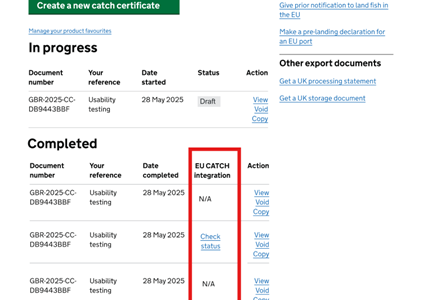
Clicking the link in the column will enable the customer to check the document’s integration status.
What if there is no check status link?
You will not see a ‘check status’ link for documents for exports not going to the EU. For example, documents for exports to China will not be transferred to EU CATCH.
What statuses can the FES user expect to see?
There are three statuses for FES-EU CATCH Integration:
- Pending – the information is still in the process of being sent.
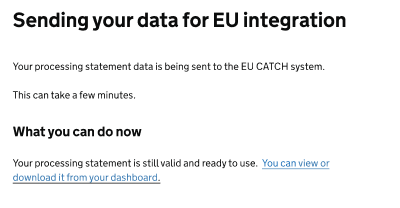
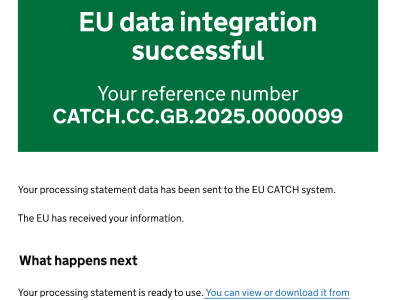
2. Success – the information has transferred to EU Catch successfully.
3. Failure – the information has not transferred to EU CATCH.
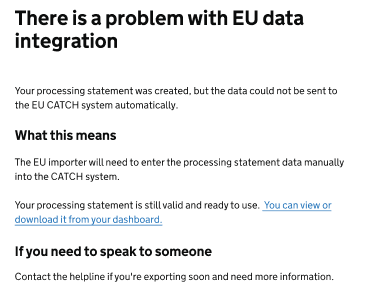
Even in the case of integration failure, UK exporters can continue with their export as normal.
Exporters should continue to send a PDF copy of their documents for export to their importer regardless of the status of the transfer, to ensure the data reaches its correct destination and exports continue to flow without interruption.
What do I need to input for the container carrying my consignment?
CATCH will only accept ISO-formatted container numbers – four letters followed by seven digits.
If you do not have an ISO-formatted number for your export container, please leave the container field on the catch certificate blank to ensure non-compliant format do not lead CATCH to reject the transfer.
If you believe you do have a correct ISO container number but the system still rejects it, please report the issue to our contact centre on 0330 159 1989 (Monday to Friday, 8am-6pm) or contact the SLO at UKIUUSLO@marinemanagement.org.uk.