
Support for our Exporters
What is happening?
As of 10 January 2026, exporters will now be required to provide additional information for seafood leaving the UK. As a registered user of the Fish Export Service, you need to act early to familiarise and adopt the changes, to ensure you can continue to export fish and seafood products. With just weeks to go, these changes will apply to all documents created within the Fish Export Service.
How these changes affect you?
As of 10 January 2026, to continue exporting seafood from the UK, you will need to provide this additional information. Without it, you will not be able to obtain your export documentation and send your consignments.
These changes will apply to all seafood and fisheries exports from the UK.
Some fish and shellfish produce are excluded from the definition of ‘fishery products’ and do not need an IUU document for export. This includes scallops, mussels, clams, cockles, ark shells and oysters. Some flours, meals and pellets of fish, crustaceans, molluscs and other aquatic invertebrates intended for human consumption are also exempt. Please check for a full list of exemptions with the competent authority of the import country via Annex II of the EU reg Regulation – 1005/2008 – EN – EUR-Lex
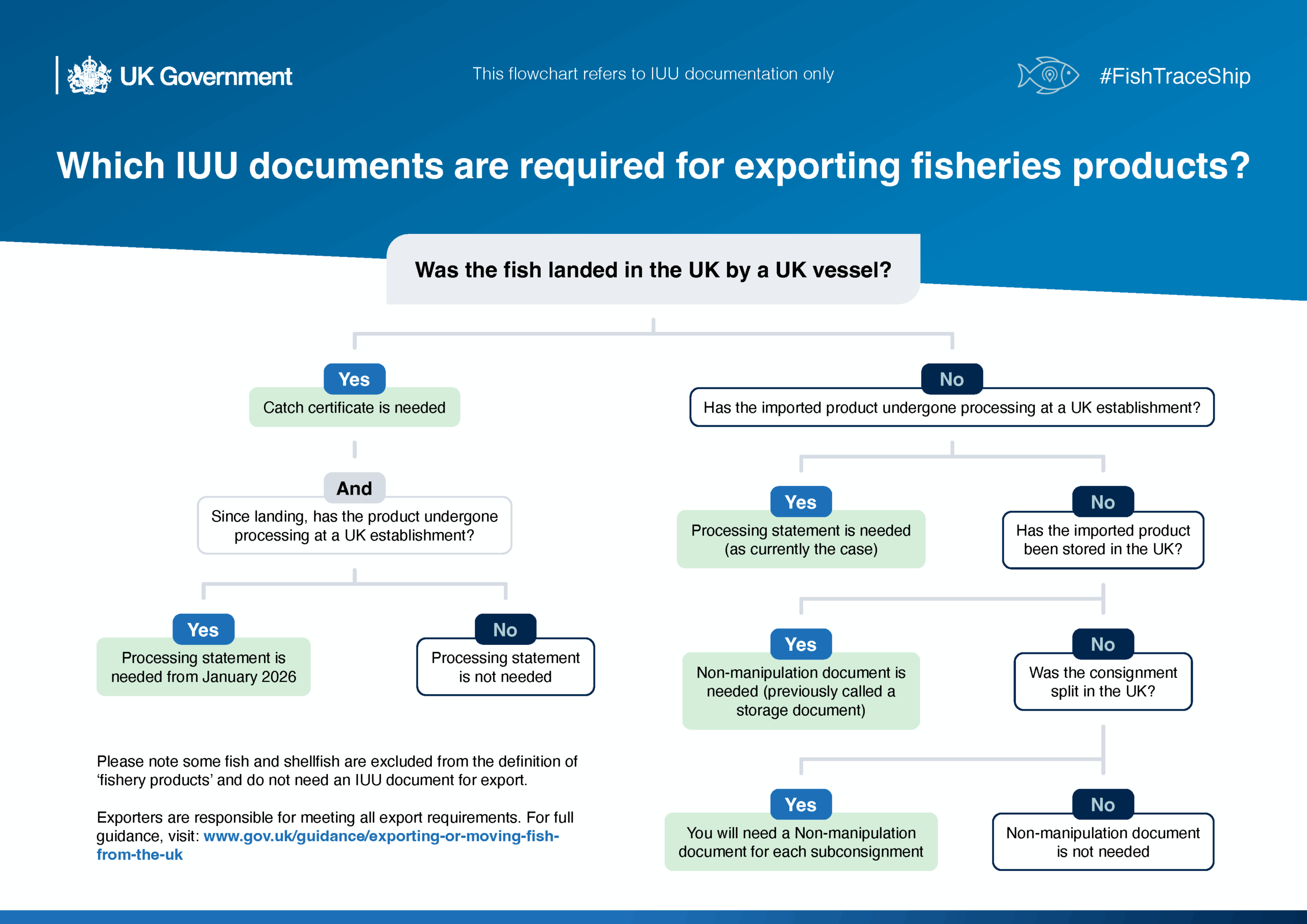
1. What is changing – Catch Certificate
As of 10 January 2026 the following additional information is required for the Catch Certificate:
- The start date of the fishing trip
- The gear type used
- Information relating to the first mode of transport leaving the UK
- The area of catch (which exclusive economic zone (EEZ) the catch occurred in, if any catching took place in the high seas and whether there is interest from a regional fisheries management organisation (RFMO)).
These changes have already been introduced for you to start using.
2. What is changing – Catch Certificate Data Upload users
For users of the data upload feature to create their catch certificates, there is now a new version of the csv file to include start date of the fishing trip, gear type used and area of catch information.
We have issued detailed guidance to support data upload users and publishing this on our Gov.uk pages.
3. What is changing – Processing Statement
The new Processing Statement is now live in the FES system.
All seafood business should be aware that as of 10 January 2026, a Processing Statement is required for ALL seafood caught by UK vessels and subsequently processed after landing in the UK. Processing Statements will also need to show the weights of each type of seafood that has contributed to each processed product.
Detailed guidance is available to explain these changes and how to complete a processing statement alongside a catch certificate.
Businesses that currently produce processing statements now need to use the updated application that is live on the system
‘Processed’ means any seafood that has been cut, filleted, canned, smoked, salted, cooked, pickled, dried, or otherwise prepared for market. Fish which has only been frozen and/or packed will not require a Processing Statement.
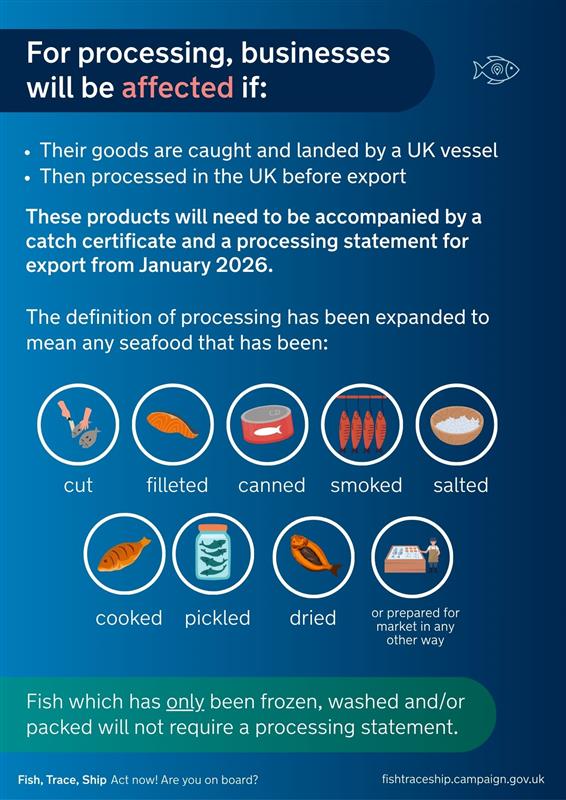
Exemptions to this include some fish and shellfish produce that do not need an IUU document for export, including scallops, mussels, clams, cockles, ark shells and oysters. Some flours, meals and pellets of fish, crustaceans, molluscs and other aquatic invertebrates intended for human consumption are also exempt. Please check for a full list of exemptions with the competent authority of the import country via Annex II of the EU reg Regulation – 1005/2008 – EN – EUR-Lex
4. What is changing – Storage Document
Changes have now been made to the storage document application form. The storage document has also been renamed to non-manipulation document.
As of 10 January, when a consignment is split into sub-consignments before export, each sub-consignment must have its own non-manipulation document.
If the relevant information is not provided and passed on to the exporter, you may not be able to sell your produce to the exporter, you may not be able to sell your produce.
Take Action: Act Now! Get on Board!
Adopt the new changes as soon as you are able. UK fishing authorities strongly advise you to familiarise yourself with the updates in FES and start to provide the relevant information ahead of time.
Discuss these changes with your supply chain to ensure that the required information is understood and supplied. As of 10 January 2026 this information is now an EU mandatory requirement and without it, you will not be able to complete your application for export documentation.
These changes are set out in the EU’s illegal, unreported and unregulated (IUU) fishing regulations and came into effect on 10 January 2026. These changes are separate to, and unaffected by, the outcomes of the UK-EU reset deal of May 2025.
You can read more in the EU Frequently Asked Questions document.
How we are supporting you
UK fishing authorities have published new guidance explaining these changes.
We have published some FAQs to help you understand what you need to do and why.
We held series of online webinars for you to attend and you can recap here.
Please remember #FishTraceShip and get onboard with the changes.
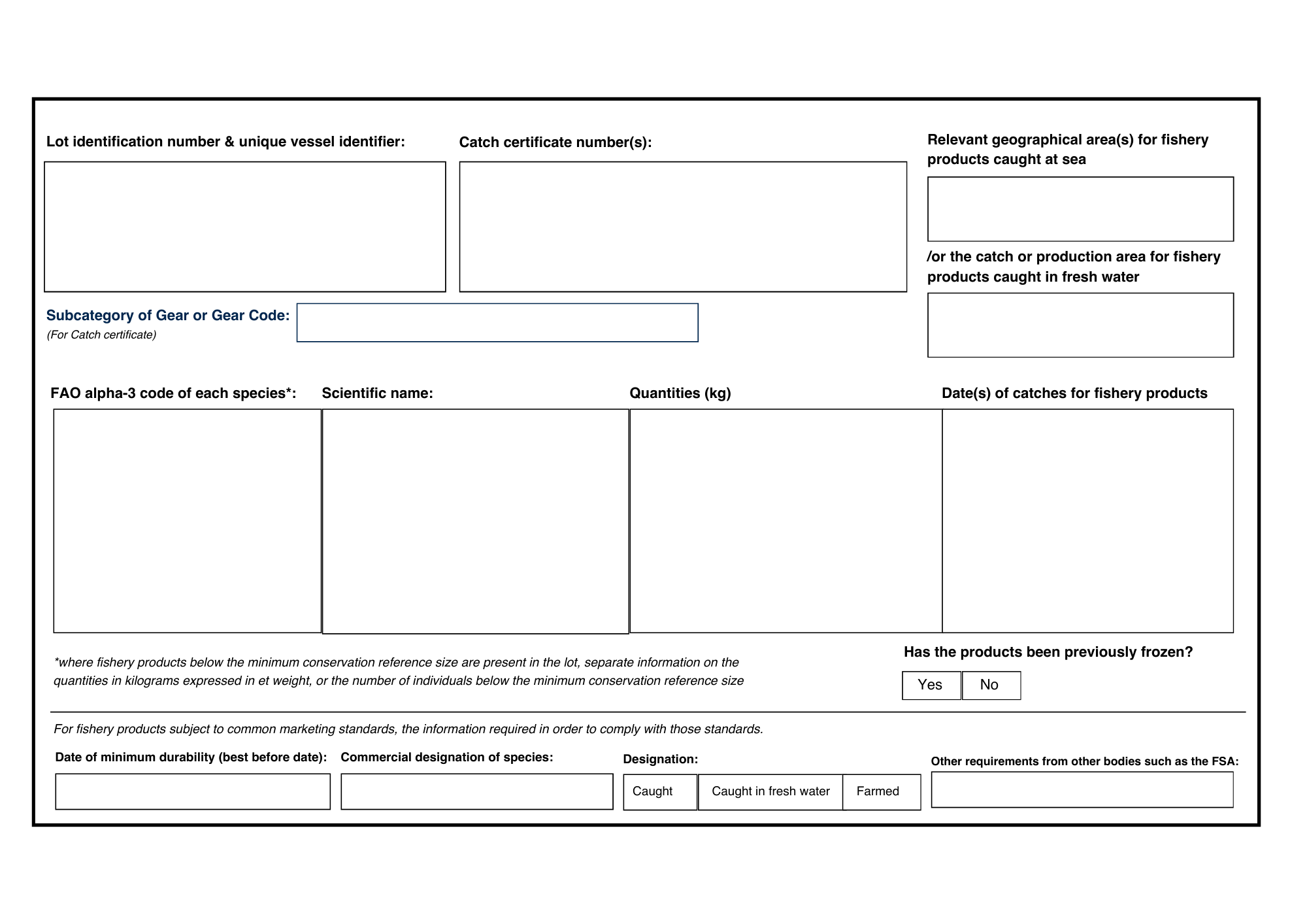
Label example
Please note these are example label templates based on UK understanding of the new EU regulations and should be treated as guidance not a requirement. This guidance may be subject to change at short notice if further information is received from the EU on the expectations for importers. Please ensure you undertake your own due diligence in preparing for the changes on 10 January. This template only covers requirements under Article 58. of Regulation – EU – 2023/2842 – EN – EUR-Lex, there may be additional labelling requirements originating from other legislation such as ingredients list.